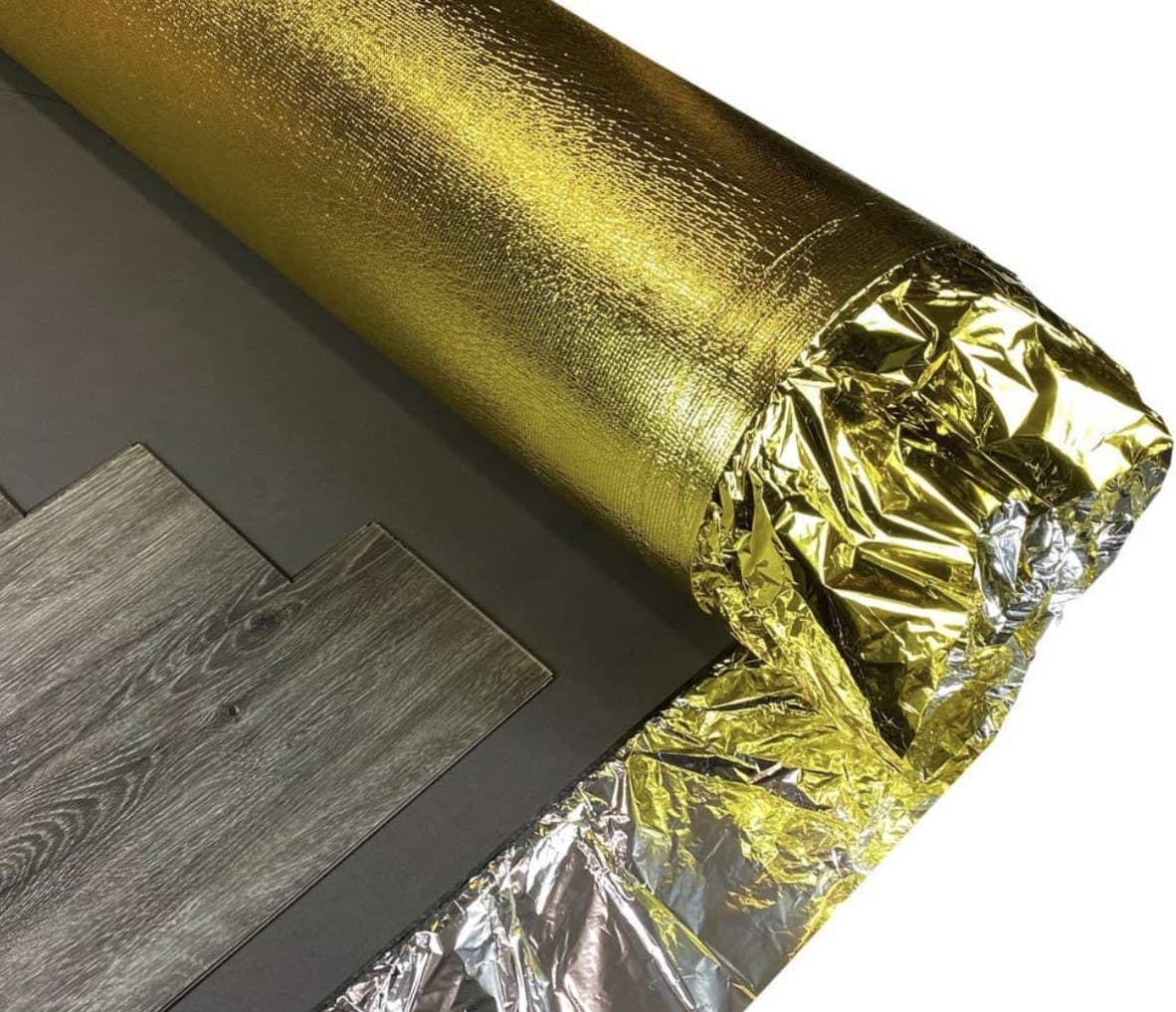
Underlayment looks like the least important line on a flooring quotation, and it is quietly one of the most consequential. The pad under a rigid-core floor decides how the floor sounds when walked on, how it behaves over damp concrete, how level the finish feels underfoot, and how much stress the click joints absorb over years of movement. Two shipments of the same SPC plank with different pads produce two completely different floors in the customer's home.
EPE - expanded polyethylene - is bead foam, the familiar lightweight white material sold in rolls. It is inexpensive, widely available, and does the basic job: it cushions minor subfloor unevenness and softens footfall somewhat. Its weaknesses show with time and load. Bead foam compresses permanently under point loads (chair legs, refrigerator feet, heavy furniture), so the floor can develop a hollow, loose feel in traffic lanes after a couple of years. Its open-ish bead structure also transmits more impact sound than a denser pad.
IXPE - irradiation cross-linked polyethylene - is manufactured by irradiating polyethylene so its molecular chains link into a uniform closed-cell sheet. The practical differences matter to any buyer: IXPE holds its thickness under long-term load (it recovers instead of crushing), its closed cells absorb impact sound noticeably better, it does not absorb water, and it is produced in consistent, smooth sheets that print and laminate well onto plank backs. It costs more per square meter than EPE - that is the whole trade-off, and for most rigid-core applications it is worth it.
The biggest practical decision is not IXPE versus EPE alone, but pre-attached versus loose-laid. SPC planks ship from our lines with 1.0 mm or 1.5 mm IXPE pre-attached to the back. Pre-attachment removes an entire installation step, eliminates the possibility of the pad slipping, bunching, or being omitted entirely by an untrained crew, and guarantees the pad-per-plank match. Loose-laid rolls (usually EPE) let you choose the thickness per subfloor and reuse the same roll across projects, but they add labor, add an SKU to manage, and quietly become the source of a share of installation complaints.
Acoustic performance is where buyers get misled most, so an honest note: no thin foam turns a hard floor into carpet. What a good pad does is kill the hollow drum sound of a floating floor and take the sharp edge off impact noise. For multi-family and hospitality projects, impact sound is usually a specification requirement - tell your supplier the building type and ask for the pad and plank combination that meets it, rather than comparing 'dB' figures from different labs, which are not comparable unless the same test method and assembly are stated.
Moisture is a subfloor question, not a pad question. SPC itself is waterproof, but the concrete below is not, and vapor drive into the plank edges and room air is the real risk. Standard practice over concrete is a separate polyethylene vapor barrier of about 0.2 mm under the floor (or per the pad system's specification), regardless of whether the pad is IXPE or EPE. Neither pad should be asked to do the vapor barrier's job. On upper floors over wood subfloors, the vapor layer is usually unnecessary.
Thickness: for pre-attached pads, 1.0 mm is the all-round residential choice - firm underfoot, keeps click deflection low, and adds almost nothing to carton volume. 1.5 mm suits projects with slight subfloor irregularity or where a softer, quieter step is wanted. Thicker is not automatically better: an overly soft or thick pad lets planks deflect at the joints under load, which is exactly the stress that eventually wears click profiles. Match thickness to subfloor condition, not to the idea that more padding is more premium.
For importers and distributors, pre-attached IXPE also simplifies the business side. One SKU instead of two, no separate pricing of rolls, fewer installation steps to explain to your dealers, and fewer warranty disputes traced back to a pad that was never installed or was installed upside down. The modest per-square-meter premium over loose EPE is usually repaid by the first avoided complaint.
At SHUCHAN FLOORING, SPC ships with 1.0 mm or 1.5 mm IXPE pre-attached as the standard option, and loose EPE rolls with a matching vapor barrier are available when a project specifies them. Underlay and skirting travel in the same container as the floor, so a single delivery covers the full installation package - the loading plan in our container guide already reserves the leftover height above the pallets for these cartons.
Tell your supplier three facts about the project - subfloor type, building type, and local expectations on sound - and the pad decision makes itself. Send us those three lines and we will return the plank-and-pad specification with the quote, including whether a separate vapor barrier is needed for your climate and subfloor.